Saturday, November 10, 2007

There's a Reason it's Called "Gossip GIRL."

TEEN STAR ZAC EFRON REPORTS FAVORITE CARTOON AS "ROCCO'S MODERN LIFE!"


...No wonder all celebrity headlines star women. Would you pay $3+ to read about Zac Efron's cartoon suggestions? Didn't think so...and neither would I.

As a big magazine consumer myself, I know what sold me and what didn't. Human nature forces us to be interested in scandal, and see or read about people during times of distress, whether that be for the sole purpose of amusement or to be able to say "I'm glad that's not me." As harsh as that sounds, it's only true. There are the rare occasions where celebrities have babies or get married, and people like to read about that in celebration, but do they sell half as well as magazines starring gossip and scandal? It's very doubtful.

So why is the world so infatuated with women in distress and not men?
When was the last time you looked at an article about a womanizing man or a man doing drugs and thought "I HAVE TO HAVE THAT?"
If you're a female reading this, you probably just said "rarely." And if you're a male reading this, then you probably just said "never, but that doesn't normally happen with magazines featuring women either," which is exactly the point. It's the main point in this whole "why aren't men the targets of gossip?" debacle.
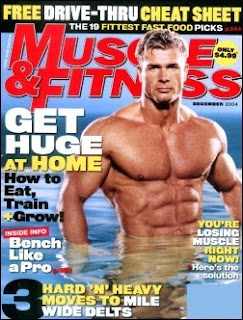
How many men buy magazines about gossip or whose doing what drug or what rehab centre so and so is in? Furthermore, how many males even buy magazines period? I'm sure there are those rare cases of the males trying to bulk up and are obsessed with the "quick tips to bulk up" in Muscle and Fitness or let's face it-porn, but truly, what's the ratio between females and males buying magazines? I'd have to say it must be a huge gap. Not only because females are just more likely to want to be socially inclined to the entertainment world, but also because it’s no secret that women tend to pamper themselves more than their male counterparts-and that means buying unnecessary, useless things. I know there are not many women that can say they don’t enjoy a nice bubble bath, with candles and a Cosmo. Women love luxury and a magazine is not the most practical purchase in the world.

This is obviously a double standard in the media. And I am most definitely all for women’s power, and equality amongst the sexes, but this is one of those double standards, in my opinion, that is acceptable. If the tabloids were smart, which it seems as though they are, they would continue to do what they’re doing. The magazine industry is a billion dollar industry, and I am certain that if they started to broaden their scope and create more of a 50/50 standpoint on entertainment news, their sales would most definitely go down.

The bottom line is that women love gossip. They love hearing about women that seem more glamorous than them, and that their husbands and boyfriends fantasizes about, in misery. There's even a new show out called "Gossip Girl," which evidently targets them. Females also love magazines about gorgeous men, and how hot they are, but there are only so man hot men in the world, and there are also only so many times a magazine can print in issue like that and expect to sell it. And as for males, the most they’ll do is read is skim the magazine on the coffee table while their wives or girlfriends are taking forever go to get ready. So why not continue to print magazines that contain exactly the kinds things your target audience likes to read?

Thursday, November 1, 2007

In Attack of Herouxville

"In Defence of Herouxville"' sheds the small town in Quebec in a different light. The article praises it for essentially its foot down against allowing such a strong sense of multiculturalism. It goes on to ask the question “how far should we go to accommodate immigrants?” And finally, it basically states that the citizens of Herouxville are smarter than the rest of us.

This is one of the most ridiculous things I’ve ever read. It is old news that Quebec has always thought of itself as being independent from the rest of Canada. The 1995 referendum in is evidence of this, but how can one agree that Herouxville- one of the most intolerant cities in arguably all of the world justified or smarter than the rest of us? Canada is a country known for its tolerance and allowing people to come in with open arms. Herouxville just shoots that notion to hell.

Canada has never truly had an identity. Before it became independent from Britain in 1867, it was simply known as a colony of the UK, and after that, it still didn’t establish an identity at all.t all. After its campaign to promote immigration in the early 1900’s is when Canada began to start to have an identity defined by multiculturalism. It is known as the mosaic, thus, how can an educated person ask how far we should go to accommodate immigrants when the foundation of its identity is built upon immigrants? This is the only way we differentiate ourselves from the the melting pot-the Americans-by not forcing citizens to assimilate to one prototype. Canada is a country which was developed upon by immigrants, people from other countries, and yet, author Johnathan Kay can still call Herouxville moral? Blasphemy

The 14 page submission has absolutely absurd requests. And continues to call Quebec a separate entity. It is not, and the citizens of Quebec need a sincere reality check. Quebec has always been an nonconformist though. It’s already pretty intolerant of English. It should be obvious that going to Quebec only knowing English is probably a bad idea, but Quebec, for the most part hates everyone-Anglophones, Francophones from Paris and Herouxville is evidence that it dislikes everyone else.


Now I’m not saying that Canada, or any province or city within Canada should bend over backwards to meet the needs of their citizens. There are certain boundaries which need to be created and certain lines that needn’t be crossed. For instance, Canada has two official languages, one of which is necessary for survival in Canada, and ESl and FSL programs cater to that. Furthermore, when it comes to safety versus religions or different cultures, safety is always the priority, like the case of the student with the Kirpan, but not being able to wear a Hajab, or for speaking French to be mandatory, etc, it is truly unreasonable to expect. To ask those things from citizens is absolutely ridiculous and to promote a “follow our rules or hit the road” policy is even more absurd.

What’s even more interesting is the the authour of the article was born in Montreal and graduated from Mcgill. I doubt this is any coincidence. I think it all just comes down to the fact that as harsh as it is to generalize; most people from Quebec are snobby, “think we’re better than everyone” separatists, and are just starting to become a burden on the rest of Canada if they’re going to enforce rules like those of Herouxville and expect people to follow them. In the end they need to realize that they aren’t a separate country, or even a separate state. They are a part of Canada, and need to act in accordance of this fact.

Sunday, October 28, 2007

Into Africa; China's manipulative role in Darfur

It is no surprise that China is an up-and-coming superpower. The progress that it has made in the last 20 year has far surpassed the progress that some countries have made in their entire history. "Into Africa" was simply a weak attempt by the CBC at calling China a manipulative country, using its "diplomatic efforts" as well-planned intelligent political and economic moves.

The whole article goes on about the marriage between China and Africa and how Africa will soon become incredibly important to China. All of this is nice and dandy, however, it fails to mention what the most important relationship between the two countries is. It hints at the situation in Sudan, but what exactly is going on there? A little thing I like to call The Next Rwanda.

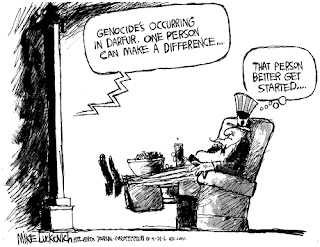
We all knows that there is murder going on in Darfur, yet everyone is hiding behind the term "genocide," or what has been referred to as "acts of genocide." The Genocide Convention essentially states that until someone officially refers to it as a "genocide," it should not be treated as such, yet...when is someone going to step up to the plate? When is enough enough?

The story is basically this: the government in Sudan, situated in the capital of the country, Khartoum has hired several militia men on horses called the Janjaweed. Why? To kill innocent citizens as result of the accusations that the government has been suppressing non-Arabs. Who is doing something about it? No one. Wouldn't you think that after Rwanda, the UN would learn its lesson and be the first to do something about the genocide going on in Darfur?

...Here's where China gets involved.

The UN Security Council is a group of 5, permanent countries which are charged with maintaining international peace and security. It has been around since its first session in London in 1946. The 5 members, in making all of these decisions have a special power called the veto. What this means is that Article 27 of the UN Charter states that all decisions require affirmative votes of these five members, and without it, the UN cannot proceed with any of its proposals. Who is involved in this security council?

France
Russia
UK
United States
China

What does this mean?
China, the country with the rapidly growing economy has been using its veto so that nothing will be done in by the UN in Darfur.

The article mentions that 62% of exports to China from Africa from 1999-2004 were OIL. With precious oil wells discovered in Sudan, by China, why would it want to risk the destruction of these wells in order to simply save thousands of innocent lives in Africa? I have to ask the harsh question on every one’s mind; who really cares about Africa?

Knowing all of this and understanding Chinas shameful role in Darfur only leads me to the conclude that the entire article written about the relations between China and Africa was neither harsh, nor controversial, and not even close to the truth about the underhanded situation involving China.

The article leaves the reader with this:
So, China's honeymoon of investment in Africa may be coming to a close as the Chinese discover that economic relations cannot be dissociated from diplomacy or good corporate behaviour.

If I were to have written the article it would have read something like this:
So, China's honeymoon of investment in Africa may be coming to a close as the world discovers that China is a manipulative, underhanded country whose "diplomatic efforts" should not be confused with its true motives; self-interest and economic growth.


Sunday, October 21, 2007

CCA 1 & 2

CCA#1

Our self-concept shapes how we communicate with others in the present, and can also influence our behaviour in the future (61). This idea, known as the self fulfilling prophecy can occur when the expectations of one person govern another’s actions (63). In my personal experience, the self fulfilling prophecy is most prevalent in a family setting that consists of more than one child, and can be either a negative or positive catalyst for the behaviour of children. For example, my family is comprised of two children; my brother and me, who fit on opposite ends of the spectrum. Everything that he does is picked apart and scrutinized, which according to the self fulfilling prophecy, explains all of his negative behaviour. Throughout his life, he has never been a strong academic student, has gotten his license suspended as a result of drunk driving, and has deceived my parents into thinking he was attending university, when in actuality; he wasn’t. These examples come as a result of the constant scorn he faces from my father telling him that he has never been good enough, and that he will not becoming anything in life. Conversely, my parents have always supported me, and told me that I am capable of doing anything. As a result, I have succeeded in most things I have attempted. For instance, I have always been a stronger academic student than my brother. There is tangible evidence of this in our report cards, as well as in our parent-teacher interviews. My parents have always been disappointed after hearing about my brothers progress, yet they have always been content and proud with mine. These examples are evidence that the self fulfilling prophecy is crucial to understand and consider in one’s family, because it can be the determining factor in a child’s behaviour. This is important to remember when your child or future child comes home with a bad report card. You must sincerely consider exactly how you react; it could mean success or failure in your child’s future.

CCA#2
Perception and culture are two ideas which are so inherently intertwined, that we tend to forget that the former is so powerfully shaped by the latter (116). Every country is shaped by one of the two types; high or low context (117). In my experience, the United States is one of the lowest context cultures, and its media does not attempt to portray it in any other manner. There are several examples of the ‘what you see is what you get’ principle when we look at the American media. Firstly, in response to the delayed reaction of the U.S. government during Hurricane Katrina, rapper Kanye West, stated “George Bush doesn’t care about black people.” Instead of sending his message in “politically correct” fashion. West directly attacked the president, ignoring the ramifications that could have come as a result of speaking his mind so directly. Due to the fact that the U.S. is low context, there are several of these kinds of guileless examples seen in the media. Similarly, Natalie Maines of the Dixie Chicks stated that she was ashamed the President of the United States is from Texas. Both statements openly attack the highest governmental figure in the country; a trait which would only be tolerable in a low context culture. They are direct, verbal statements which send a clear message. In one of its high context counterparts, like South Korea, these controversial statements would be seen as rude and disrespectful. They would not be promoted in the media, nor would they even be thought of because Eastern cultures promote the idea of social harmony. The difference in volume of these countries is one of the reasons it is so difficult for citizens in different cultures to adapt to living in other countries. Whether a low or high context culture is more beneficial in communicating can be left up to you to decide, but it is impossible to deny that problems within a country, specifically for George Bush can be partially attributed to said volume.

Adler, Ronald B., George Rodman, and Alexandre Sevigny. Understanding Human Communication. Don Mills: Oxford UP, 2008. 61-117.

I Now Present Mr. and Mrs. Prime


The day has finally come. The day you’ve been waiting for your whole life. Everything’s perfect; your dress is ironed out perfectly and stainless. Your hair and makeup are done flawlessly and you’ve even refrained from crying so that your mascara won’t run. You stand there, looking at your smiling father who’s trying not to cry; he doesn’t want to let his little girl go. Your hearts beating faster than it ever has and the priest begins. “Do you _____ ______ take R2D2 to be your lawfully wedded husband?”
Wait. What?


No, according to David Levy, the AI researcher at the University of Maastricht, this isn’t just a nightmare you want to wake up from. To him ” "It may sound a little weird, but it isn't," Levy said. "Love and sex with robots are inevitable." And that includes marriage.


The real question I'm having problems with in regards to the article “Sex and marriage with robots? It could happen," is whether or not I am truly supposed to take it seriously. In all honesty, instead of a serious, informative article based on valuable research, it seems like a satirical piece of writing, created to poke fun at society. What have we come to as a society, when we have to use artificially developed machines in order to provide those deprived individuals with intimacy?


After skimming through the article for first time, I forced everyone I know to read this quote:


"My forecast is that around 2050, the state of Massachusetts will be the first jurisdiction to legalize marriages with robots," artificial intelligence researcher David Levy at the University of Maastricht in the Netherlands told LiveScience.


If this isn’t one of the most ridiculous things you’ve ever read, I’m forced to question the things that you read. It’s unbelievable that in a society, struggling with issues such as same sex marriages, and even where interracial relationships are ‘frowned upon,’ it is thought that marriage with robots will be seen as a “norm.” What is society coming to when an absolutely ludicrous idea like this will be allowed? At first, it may seem like a funny and even interesting thought, but when taking an idea like this seriously and actually thinking about the repercussions of allowing people to marry robots, it just gives me a solemn, scared feeling.


In dealing with an issue like this, it’s important to consider the root of the cause; where exactly did an idea like this even come from? What compelled someone to consider creating a business like this? After fighting with myself over this question, and thinking that “people a insane” was not the reason, I’ve come up with a pretty simple hypothesis:


Human beings are lazy. (and perhaps a little bit insane)


At face value, this is something which is certainly obvious, but I feel like this is turning into a problem of epic proportions. It’s obvious that our society is a lazy one, but if it’s come to a point where we are so obsessed with efficiency, and it has become too much of an inconvenience to “look for love, how can we not sit back and consider the fact that we may have a serious problem on our hands? We’ve all had our share of bad relationships, and yes, they are difficult, emotionally, and financially strenuous, however, I’m hoping I’m not the only one that would never, even for a second, consider marrying a robot. There are just too many reasons that make this a ridiculous notion; for one, the social repercussions. Not that it really matters, but what would others say if I rolled up to my fancy, office party and introduced everyone to my loving husband, Optimus Prime? Secondly, I wonder what my parents would have to deal with if I sent out wedding invitations to their closest friends which stated:


On ________, you are cordially invited to the wedding of Rose Sharifi and Voltron


There are too many questions when it comes to the idea of robot marriage to even consider it as a realistic idea. How is David Levy going to tackle the physical aspects of a robot? How are the robots going to have the warmth of human beings? What are they going to feel like? When I think of robot, I think “big, cold, metal, box.” I’m not sure more than... 2 in 6 billion people would find a spouse like this appealing, because I know I sure as hell don’t. There is also the financial aspect which would be a problem in marrying a robot. I’m not sure one could depend on their robot spouse to be a breadwinner of the family. There’s another idea; family. There’s not only the issue of raising a family, but how is one supposed to even have children with a robot spouse? Does sex with a metal box even sound pleasant or even realistic?


I’m sure you agree that I don’t think robot marriage is realistic, but I haven’t even talked about the fact that it’s just plain..sad. I just feel like it’s a pathetic notion to have to get married to a robot. Yes, there are individuals that are self conscious and think that they are ugly or not good enough, but no one has to stoop to the level of marrying something so artificial. Isn’t it more psychologically damaging to marry something that you know is programmed to love you than not have love at all?


In the end, instead of an intriguing idea that could help poor, lonely individuals in the world, this just seems like a scary idea from a sci-fi novel gone wrong. A sci-fi novel that no one should ever consider reading...


Sunday, October 14, 2007

...What Referendum?


Can we honestly say it was truly shocking that the referendum didn't pass? As someone who learned about the details approximately two days before the election on a pamphlet that was thrown on my dining table, I'm going to have to respond with a no.

As the article states, there was most definitely not enough information provided to citizens about the referendum. People have a hard enough time trying to keep up with the elections and candidates themselves; not making it clear what this referendum was about just had them not caring. As a poli sci major, I should understand Canadian politics down to a t, but the truth of the matter is that I don't... and I'm sure many Canadians are in the same boat. From what I understood, the referendum was essentially a way of trying to make a complicated system more complicated, and who would really go for that? More important, why would anyone if they don't even know what they'd be going for?

Unlike the 1995 Quebec referendum which most of the population probably knew about and understood, the most that one could have expected for this one is that it had to do with a change in the electoral system, but not even many knew that. Furthermore, in the 1995 Quebec referendum, a budget of $5 million was set for EACH committee. How much was spent for this years referendum? 6.8 million. And what was one of the primary sources of information that was sent out?

...Leaflets through the mail:

There are too many things wrong this scene. It seems like the government simply got lazy in providing information that could have been vital to the MPP electoral system. It could have gone either way if people actually knew what they were voting for, but with the poor campaigning, how could they? Prior to the election, the information I learned about the referendum was through a pathetically laid out commercial that had the words "referendum" in it and a pamphlet I happened to pick up while sitting at my dining table. Even then, the information on it was still confusing. Not that I’m saying I’m the most intelligent person when it comes to Canadian politics, but I do have a decent grasp on it. It was hard enough fully understand the change, let alone understand why there was a need for one.

It doesn’t seem hard to pinpoint why there is so much political apathy occurring in Canada today. With the unfortunate 52.6% of eligible voters that cast a ballot, let’s face it... p
eople are lazy, and in a society like ours, if it’s not on the radio or the t.v., most people aren’t going to know about it. As harsh as it seems, it’s one of my most sincere beliefs. Only those who really care about the cause are going to go out of their way to find out about the election and what’s going on in politics, and by going out of their way, in our society, that just means going as far to do some research, and ask some questions. If it’s not clearly laid out for people, they’re just not going to pay attention or care. The Canadian government needs to really step up its game when it comes to letting citizens know about these things and ensuring that all the information is being provided in a clear way. Also unlike the Quebec referendum in 1995, it’s clear that 12 years from now, Canadians aren’t going to remember what the referendum was about. Instead of asking what it was about, it’s more likely that one will ask


...what referendum?

Saturday, October 6, 2007

Whither Marriage? Who Cares?

Out of all the articles that I've had to read/viewed, this week was most definitely the most disappointing. Essentially all I got out of it was that marriage rates are declining at a semi-rapid pace...

but who really cares?

By discussing this fact in a 10 minute segment, it might seem as though this issue is shocking and important, but to me, what real difference does it make that people aren't getting married? Being single is no longer taboo in this day and age. It's not really as if people in the 1980's or before truly had a choice. I may seem anti-marriage, which is ironic, being someone who is described as the 'eternal optomist' , but I feel like this particular topic is more so directed at the traditional folk, who think that getting married, and having children, is the be all and end all in a 'normal life.'

The two guests had contrasting views, which was important, because it compelled me to actually pay attention. Whereas I understand the younger, Anne Marie McQueen and her more modern views, I completely disagreed with Barbara Kay, the elder guest who seemed to have a very traditionalist point of view on everything that had to do with marriage and having kids. Call me contemporary, but I found most of what she said ridiculous, I could even go as far as to say it was pretty much blasphemy. Firstly, she stated that we, as a society are drying up, and that by not wanting to have more children, one isn't thinking about the future, only the present. What does that even mean, "thinking about the present?" She makes it seem like people hundreds of years ago, and in less developed societies were thinking about the future when they were having 8 and 9 kids, but look at our society now. We are a world that is overpopulated and undereducated. Our population now of 6,602,224,175 has done more damage to the universe than any other generation. We have polluted, destroyed, and left an irreversible mark on the world. If Barbara Kay is implying that bringing more children into the world is the key to a better future...
it's n
ot.
We should really be focusing more on what we can do now, in the present to
improve the conditions today. If this was the mindset of people before the industrial revolution, we might not be in such a difficult position right now. I'm not saying that "forward-looking" is something we shouldn't do, because face it, it's important to consider the consequences of our actions, but if by looking into the future, we are ignoring what we are doing right now, we are clearly at fault.

She went on to say that marriage produces more stable families, and that marriage implies a commitment that common- law does not. This point I agree with to some extent. As cliché as it may sound, marriage is generally something that people engage in to prove their love and devotion to each other, thus, they're essentially trying their best to prove their loyalty to each other, through thick and thin. Common-law marriage seems like an "easy-out," where you're not legally bound to each other; it's kind of a lifelong boyfriend thing. However, I disagree that marriage guarantees stability, or success in a family, which is what it seems like Barbara was trying to imply. Not all marriages produce happy, healthy children, and there are obviously instances in which common-law marriages are more successful than "real marriages." Statistics may tell me otherwise, but personally, I don't think that the stability of one's family is based on whether or not they have signed a piece of paper which legally binds them to each other. Different cases produce different results, therefore, I think saying that married couples are happier, and more stable than common-law marriages, was an ignorant, over-generalization.

Finally,
she stated that "self awareness implies selfish and that true happiness is taking responsibility, moving out of your parents home, is starting your family. It makes the most of your potential and your energies. Happiness is hard work." I may have been the only one who laughed at this part of the segment, but that's one of the oldest fashioned statements I've ever heard. Yes, most of us should come to an age where taking responsibility for things does make us happy, but happiness SHOULD NOT be hard work. Perhaps she is a really selfless individual, or maybe I'm very selfish, but I don't think that giving up your 'freedom' is a selfish thing to do. I'm someone that's very career-driven, and I plan on having one child to do my duty to the world, and that's it. Yes, I believe that we must make sacrifices in life and that family and children are important, but it's a really traditional opinion to believe that we all must have families, and children, and live happily ever after. It probably does sound like a ridiculous notion to most people, but maybe some people are happy living in their parents’ homes for the rest of their lives. In some Eastern cultures, sons are supposed to live with their parents for the rest of their lives. Our lives don’t have to be about other people. We obviously shouldn’t be the only people we care about in our lives, but the people that we do care about don’t have to be our husbands, or wives, and children. We can love our friends, our parents, our siblings, etc. And calling it selfish to not want to have children or a “traditional” family is absolutely ludicrous; it’s not the only option.

In summary, I think that this article was merely a clash of generations. I guess my disinterest in it shows that my generation is apathetic for marriage; declining marriage rates is not an issue that’s really important, and having someone who ir probably 40 years my senior telling me that marriage and a family are important is not going to have me thinking otherwise. Life has started to become about more than just that. In the 21st century, we have the opportunity to essentially do anything we want to, and this is especially important for females. I believe we have just begun to explore the world, and have opportunities which weren’t available to us before. Even our roles in marriage are evolving, and we’re simply coming to an ange where marriage doesn’t have to be an option; marriage does not equal success. Essentially, what I’m trying to get at is that being single feels damn good.